
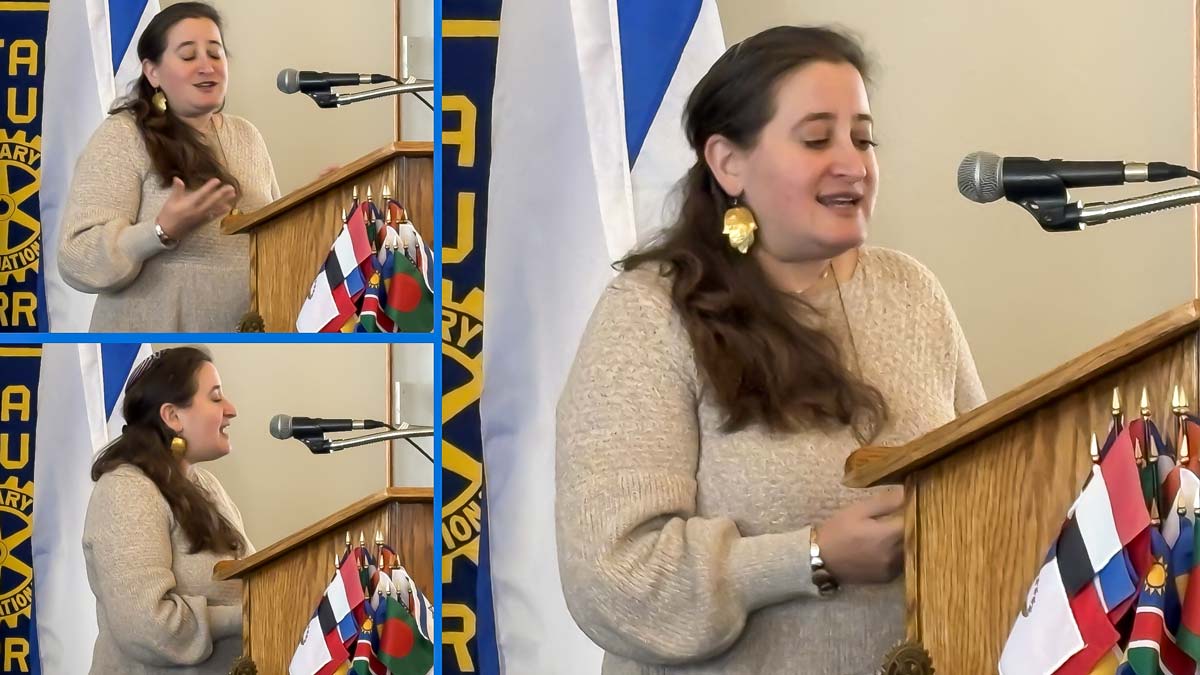
The Rotary Club of Barrie recently welcomed Rabbi Emma Gotlieb, who offered a candid and deeply thoughtful reflection on what the Jewish community has been experiencing since the October 7 attacks. She described how profoundly this moment has affected Jewish people around the world, noting that the attacks represented the largest mass killing of Jewish people since the Holocaust. For many, it shook a sense of safety that felt newly gained after generations of instability.
Rabbi Gotlieb spoke from her perspective as a Liberal Zionist, someone who believes Jewish people have the right to a homeland, while also believing strongly in holding Israel to ethical and moral standards. She shared how difficult it has been for rabbis and Jewish leaders globally to navigate a time of intense polarization, where speaking out risks being misunderstood no matter what is said. At first, she kept her discomfort private, unsure of how to express her concerns without causing division.
As the conflict continued, she realized that remaining silent felt more difficult than speaking. With the High Holy Days approaching, she chose to address the war directly in a Yom Kippur sermon she described as the scariest of her career. Some congregants struggled with her message, while others felt grateful for her honesty, but she was at peace knowing she had spoken from conscience.
Rabbi Gotlieb also worked to clarify widespread misunderstandings about Zionism and Judaism. Judaism, she reminded us, is a diverse global people and a religion, while Zionism is simply the belief that Jewish people have the right to a homeland — an idea that spans many viewpoints. She provided historical context and described the long-standing Jewish connection to the land, shaped by both sacred texts and centuries of displacement under conquering empires.
When discussing paths to peace, she acknowledged that grassroots initiatives have succeeded in bringing individuals together, but political realities make progress extremely difficult at the moment. Still, she emphasized that empathy does not need to be rationed — caring for one group’s suffering does not require diminishing the suffering of another.
The meeting concluded with a welcome touch of levity when President Todd mentioned he had only recently discovered that many beloved Christmas songs were written by Jewish composers. It was a simple reminder of how our cultures overlap in unexpected and meaningful ways.
Rabbi Gotlieb’s visit left our Club with a deeper appreciation for the complexity of this moment and a renewed commitment to approaching difficult conversations with compassion, nuance, and humanity.